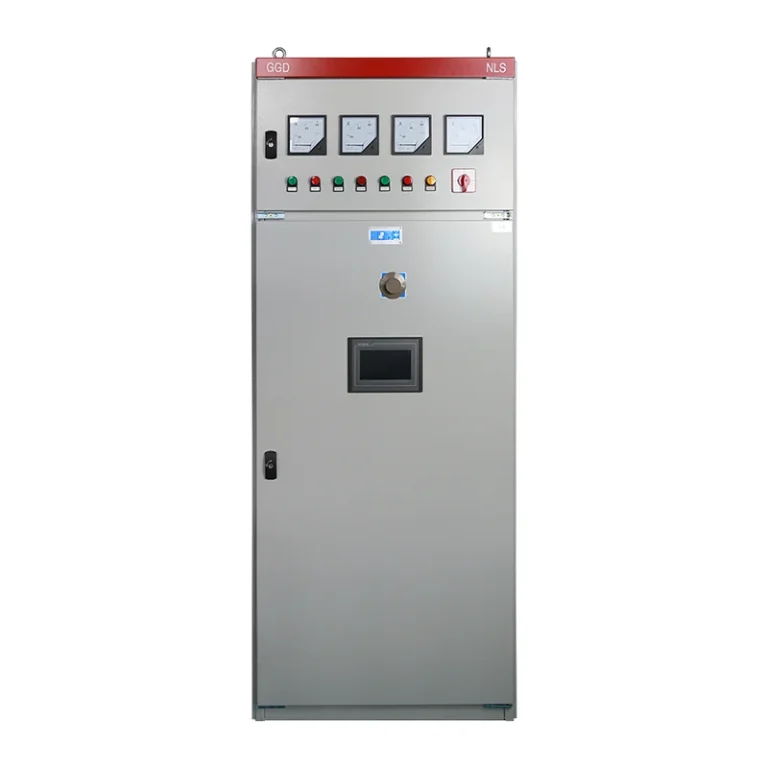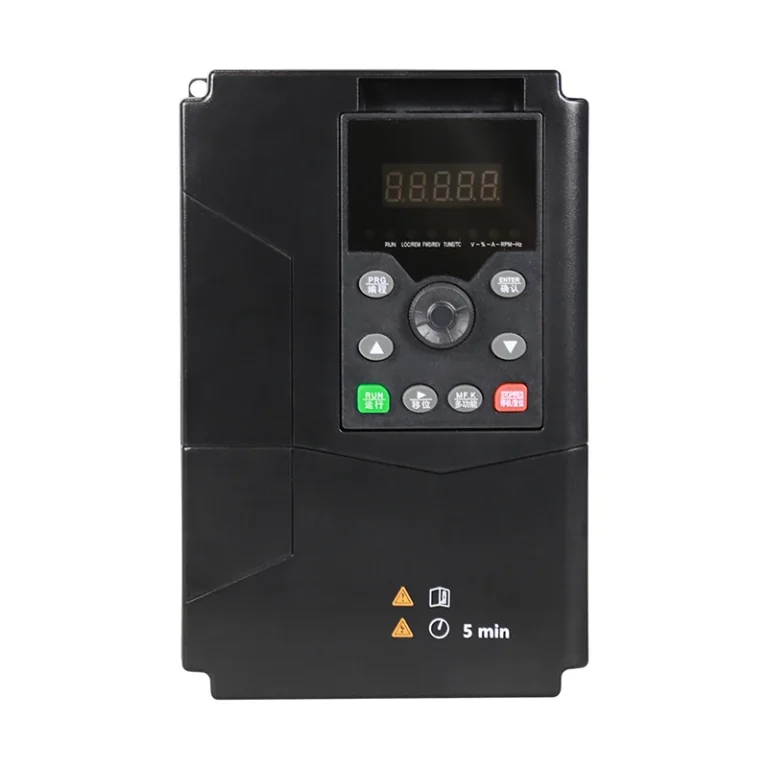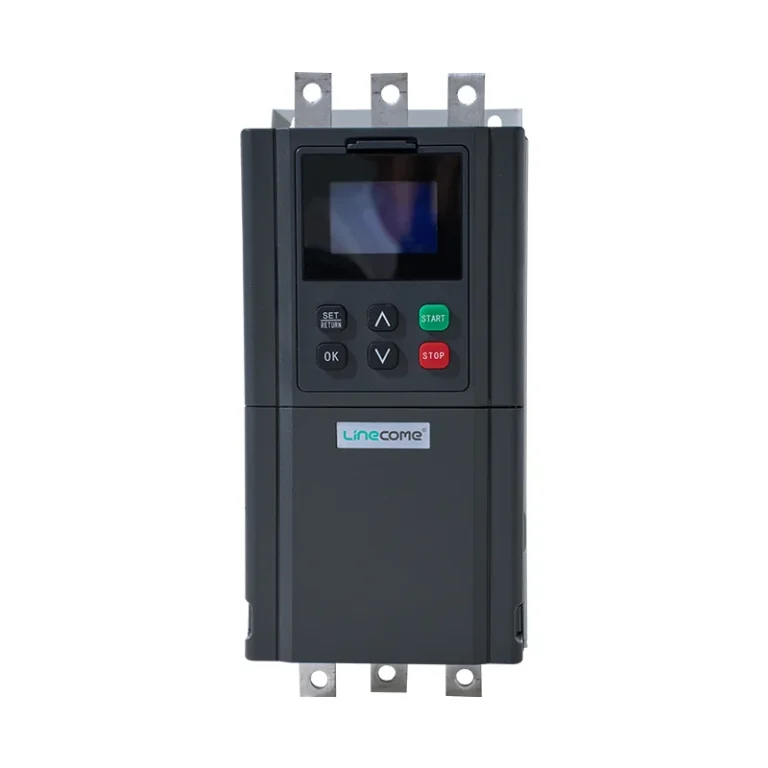

frequency converter from 60hz to 50hz searches usually mean one procurement job: keep the motor terminals at the frequency stamped on the nameplate—typically 50 Hz—while the plant utility remains 60 Hz in much of North America, Japan, and parts of Taiwan and the Philippines. For motor loads, a frequency converter 60hz to 50hz decision often comes down to a properly sized variable frequency drive (VFD) programmed for 50 Hz output, not only to a facility rotary converter sized for every branch at once.
Use the Variable Frequency Drive hub to compare drive families after you confirm the motor nameplate frequency. For bidirectional 50 Hz ↔ 60 Hz selection context, see the published 50 to 60 Hz frequency converter buyer guide—this page stays focused on 60 Hz plant feed → 50 Hz motor output.
 .
When 60 Hz plant power meets a 50 Hz motor nameplate
Imported machines keep their design frequency even when the wall supply stays at 60 Hz. A pump skid built for 50 Hz utility in Europe or Australia still shows 50 Hz on the motor nameplate when it lands in a 60 Hz North American plant, and the mismatch appears before anyone opens a converter catalog.
Motors and pump trains show symptoms first because synchronous speed follows utility frequency when pole count is fixed. Timers, control transformers, and relay coils on the same imported skid that assume 60 Hz control power usually cannot share one adjustable drive output—you plan branch hardware for the motor and separate conversion or replacement for those auxiliaries.
Speed, torque, and cooling when line frequency exceeds motor frequency
Treat synchronous speed as a nameplate problem before you quote hardware.
Connecting a 50 Hz-rated motor straight to 60 Hz mains lifts synchronous speed roughly one-fifth above the design value, which can overrun fan curves and torque margins the mechanical package was balanced for. Programming a drive for 50 Hz at the motor terminals on a 60 Hz feed restores nameplate speed for the circuit that drive feeds when ampacity, thermal limits, and tuning are correct.
Program voltage and frequency together for induction motors. A drive that tracks a sensible volts-per-hertz curve for the 50 Hz target helps avoid flux saturation or under-flux, but electronic tuning still cannot override mechanical overspeed risk or inadequate cooling at the slowest speed you intend to hold.
| Symptom on 60 Hz feed | Likely cause for a 50 Hz nameplate motor | First response |
|---|---|---|
| Higher than expected RPM | Direct connection to 60 Hz | Stop direct run; plan 50 Hz output or resize |
| Overheating at rated load | Flux or cooling mismatch at wrong Hz | Program 50 Hz output; verify fan on motor |
| Weak starting torque | Voltage/frequency profile wrong | Enter nameplate data; retune drive |
How a VFD outputs 50 Hz for the motor on a 60 Hz feed
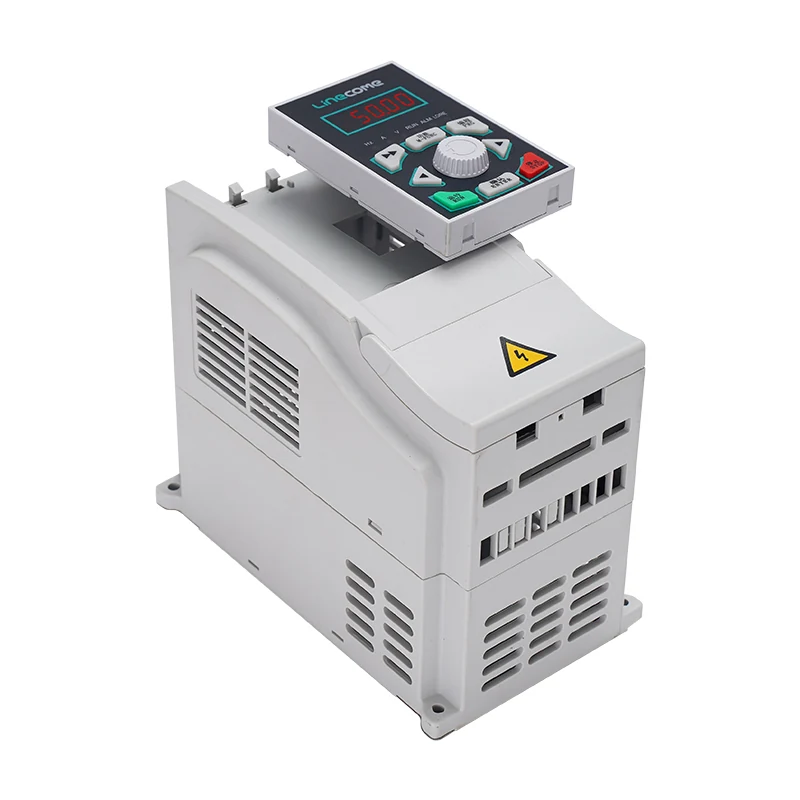
The drive front end rectifies utility power, stores energy on a DC bus, and the inverter rebuilds AC at the frequency reference you set—so terminals can read 50 Hz while the service entrance remains 60 Hz when the unit and motor are matched. Field teams often label that adjustable inverter a “frequency converter” even though it is one block inside a larger motor-control cabinet.
Scope stays at the motor branch: one VFD output serves the motor (or a single pump/fan train) you wire per the manual. It does not retime every conductor in an imported panel unless each load has its own approved conversion path.
 .
Static, rotary, and VFD options for 60 Hz to 50 Hz motor duty
When comparing a 60hz to 50hz frequency converter cabinet to a motor-branch VFD, start from load survey scope—not from habit.
Dedicated frequency converters still matter when you must feed multiple loads or when customer specs name a rotary or static converter for a defined kVA block. The table below stays at the motor-load level—facility engineers may size larger static converters when transformers and auxiliaries also need 50 Hz.
| Approach | Best fit for 60 Hz in → 50 Hz motor | Trade-off |
|---|---|---|
| VFD on motor branch | Single motor or pump/fan with adjustable speed need | Adds harmonics/EMC tasks; does not fix non-motor electronics |
| Rotary (motor-generator) | Mixed legacy loads that expect a stiff 50 Hz bus | Footprint, noise, maintenance |
| Static solid-state converter | Clean frequency change for a defined kVA block | Cost; requires accurate load survey |
| Motor rewind / replacement | Very old motors or extreme duty mismatch | Downtime; new nameplate becomes source of truth |
U.S. Department of Energy summaries on adjustable-speed drives note that matching motor speed to load demand pays off on fans and pumps—motivation that overlaps 60 Hz to 50 Hz retrofits even when the immediate task is simply holding 50 Hz base speed on imported nameplates.
Commissioning 50 Hz output while the line remains 60 Hz
Program base frequency from the motor stamp, not from wall-meter habit alone.
Start commissioning by loading nameplate frequency, voltage, and current into the drive, then lock base output to 50 Hz for this application even though the utility meter still reads 60 Hz. Ramps, braking, and thermal models remain active—commanding 50 Hz does not remove crawl-speed cooling checks.
V/Hz control (listed as V/F on many catalogs) or vector control should match the load type. Constant-torque hoists need different patience during tuning than quadratic fan laws, yet the frequency setpoint still follows the motor stamp. Record final parameters on the handover sheet so the next maintainer inherits the same 50 Hz reference.
Pre-buy checklist: 60 Hz supply, 50 Hz load, and auxiliaries
Photographs and notes reduce wrong-SKU orders before conversion hardware ships.
Before you request a quote for a frequency converter from 60hz to 50hz, photograph the motor nameplate for rated frequency, voltage, full-load amps, and insulation class. Capture transformer labels on control circuits, flag 60 Hz-only timing devices, and list any electronics that expect utility frequency outside the motor branch you plan to drive.
Important: Integrator forums warn that control boards and transformers may still fail when only the motor branch is corrected—source note: Talk:Variable-frequency drive — motor-branch scope vs plant-wide conversion.
IEC 60038 gives spec writers nominal 50 Hz and 60 Hz voltage classes; your local utility still defines measured values at the disconnect, so the checklist should record line frequency and voltage beside the 50 Hz motor target.
 .
Matching LNC820 general-purpose VFDs — product fit for 50 Hz output from 60 Hz feeds
Published series tables still require a row match to your motor amps and voltage class.
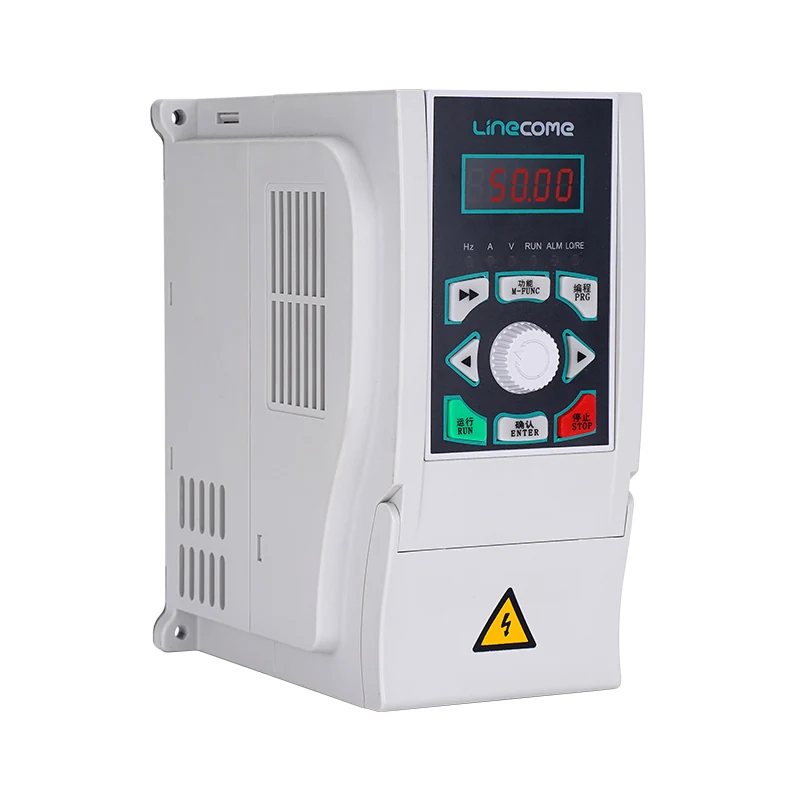
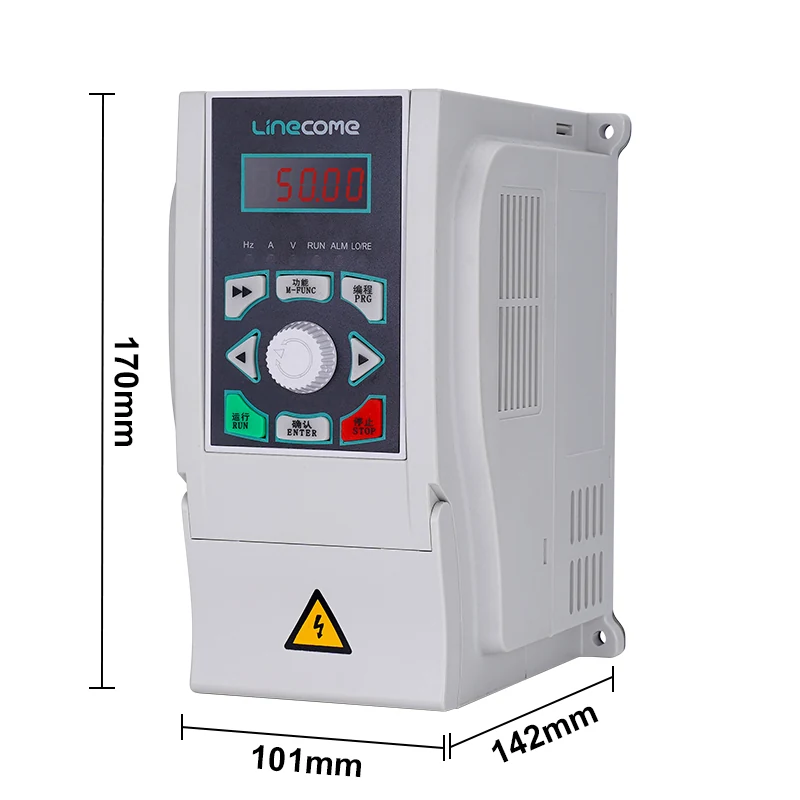
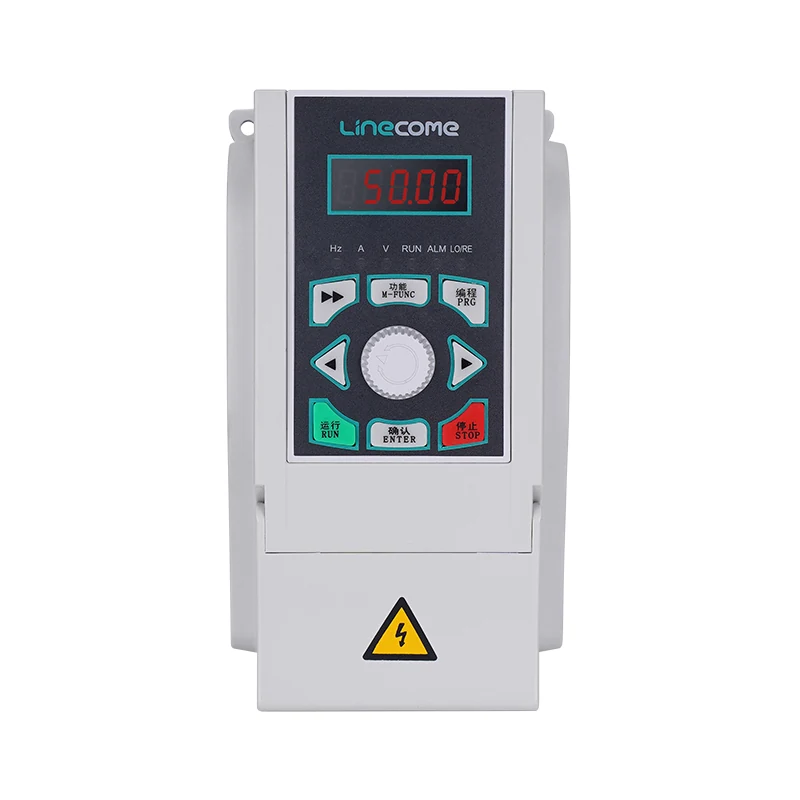
For a motor-branch example on this site, the LNC820 general-purpose VFD series page publishes 0–500 Hz output range, V/F and open-loop vector (SVC) modes, and RS485 on the overview table—data you use to plan 50 Hz output programming on 60 Hz feeds, not a blanket import approval.
Select the catalog row that matches input voltage, output current, and enclosure for your kW, then set base frequency to 50 Hz when the nameplate requires it while utility stays 60 Hz. Overview copy mentions optional built-in braking on certain kW rows; validate deceleration energy on high-inertia loads instead of assuming the braking transistor alone will suffice.
| Public LNC820 page item | Why it matters for 60 Hz in / 50 Hz motor projects | Your project still must verify |
|---|---|---|
| 0–500 Hz output frequency range | Shows electronic frequency command range | Continuous torque at 50 Hz, motor cooling, mechanical overspeed |
| V/F and SVC modes | Links to commissioning section | Motor data entry, load type, tuning time |
| RS485 on overview copy | Integration path for SCADA | Register map, baud, fault handling |
 .
Email nameplate photos and the 50 Hz target when you need help choosing a kW row within LNC820. If the machine only needs reduced-voltage starting at fixed utility frequency with no Hz mismatch, review other starters in the VFD hub before ordering conversion gear.
Frequently Asked Questions
Short answers below cover buyer decisions for 60 Hz utility feeding 50 Hz motors; terminal wiring stays in the manual for the model you purchase.
Can a VFD on one motor fix an entire imported panel on 60 Hz utility?
Rarely. One drive output retimes the motor circuit it feeds. Contactors, transformers, and control gear on the same panel that expect 60 Hz still need compatible feeds or a plant-level converter sized for their kVA.
What happens if I connect a 50 Hz motor directly to 60 Hz mains?
Speed rises with utility frequency, so torque and cooling can leave the design envelope unless the mechanical load caps RPM. Duration, load type, and nameplate voltage all matter—stop direct run and plan 50 Hz output instead of trial operation.
Is a VFD the same thing as a frequency converter?
In conversation, both phrases describe motor power supplies. In procurement language, a frequency converter can mean a fixed-ratio 50 Hz bus generator, while a VFD adds adjustable speed control around its inverter stage.
Do I need a motor rated for both 50 Hz and 60 Hz?
Apply the frequency printed on the nameplate at the motor terminals after conversion. Some stamps list dual ratings; if only 50 Hz appears, run at 50 Hz unless a qualified engineer documents a different approved duty.
Will running at the wrong frequency always destroy the motor immediately?
Failure is not always instant, yet overheating, overspeed trips, and nuisance faults are common enough to treat Hz mismatch as a stop condition. Log line frequency, target motor frequency, and current before restart.
What nameplate photos should I send before ordering a 60 Hz to 50 Hz converter?
Provide motor frequency, voltage, full-load amps, insulation class, and any existing starter or drive label photo. Include transformer and control-power labels when auxiliaries stay on the imported panel so the supplier knows whether you need motor-branch hardware only.
References
Sources below support utility-frequency context and drive behavior cited in this 60 Hz to 50 Hz buyer guide.