
The application of star delta motor starter control still appears on fixed-speed motor branches where plant standards call for wye-delta reduced-voltage start, delta run at line frequency, and contactor-based switching—buyers use that phrase on bid tabs for pumps, fans, and compressors when the motor wiring supports the scheme.
Maintenance and procurement readers comparing wye-delta application rows on bid tabs need load-type context and routing to SCR soft start or VFD when six-lead access, transition dip, or run-speed needs block wye-delta. For honest pros and cons of the method itself, read advantages and disadvantages of star delta starter—that cousin owns trade-offs; the sections below map where wye-delta still applies. Cross-link soft starter benefits, when to use a soft starter, and advantages of motor soft starter when the duty shifts to SCR ramps without winding reconnection.
Use the Soft Starter hub when reduced-voltage start is in scope but adjustable run Hz is not. If the process needs speed control during production, route to advantages of VFD instead of extending wye-delta language on the same line item.
 .
Where star-delta motor starters still apply in industrial plants
Star-delta motor starter application in modern plants concentrates on fixed-speed utility water, HVAC, and packaged compressor skids where the motor nameplate and terminal box already support wye-delta—or dual-voltage delta wiring—and the process never throttles output frequency during run.
Wye-delta remains a contactor and timer solution on those tags: reduced-voltage wye energization, timed transition, then delta run at line frequency. It is not a substitute for adjustable-speed drives when the RFQ names Hz changes across the operating day.
| Application zone | Why wye-delta still appears on specs | Typical routing when the gate fails |
|---|---|---|
| Utility and transfer pumps | Fixed-speed, frequent legacy “Y-Δ start” notes on six-lead motors | SCR soft start when leads or transition dip block reconnection |
| Centrifugal fans and AHUs | Line-frequency run; reduced-voltage start on larger motors | VFD when damper-only control is insufficient and Hz must change |
| Fixed-speed compressors | Infrequent starts; contactor economics on approved motor lists | Soft starter when transition torque stresses coupling |
| Conveyors and mixers (fixed Hz) | Standardized starter series across a site | VFD when soft acceleration must continue into run speed trims |
Bid reviewers should treat each row as an application decision—motor access, inertia, and run-speed scope—not as a universal default for every induction motor.
Pump and fan branches that commonly keep wye-delta on bid tabs
Centrifugal pump branches on municipal and industrial water systems often keep wye-delta language because the motor stayed on a fixed-speed curve for decades and the nameplate still shows dual-voltage or six-lead delta wiring. That wye-delta motor starter application pattern also shows up on star delta starter pumps fans specs copied from prior decades—same fixed Hz duty, different mechanical load. The hardware here is about starting a fixed-duty impeller, not throttling flow by changing motor frequency during run.
Fan motors on cooling towers, supply air handlers, and exhaust stacks follow the same pattern when dampers or inlet vanes handle flow and the motor runs at utility frequency full time. Spec writers copy wye-delta from prior projects because the mechanical team already sized for line-frequency operation.
From the field: Talk:Star-delta starter notes that maintenance teams still specify wye-delta on legacy six-lead fan and pump tags when the motor nameplate already shows dual-voltage delta wiring—verify the terminal box before assuming a retrofit motor matches the old application note.
 .
When a retrofit motor arrives with only three leads brought out, the application on the old bid tab no longer matches the hardware—update the spec before award rather than forcing wye-delta contactors onto an incompatible winding arrangement.
Compressor motor applications that may still specify wye-delta
Compressor motor branches—air, refrigeration, and gas boosters on fixed-speed packages—sometimes retain wye-delta when starts are infrequent, the motor list is frozen, and six-lead access is confirmed on the data sheet. The application goal is reduced-voltage start without adding inverter harmonics planning to a simple on/off duty.
High-inertia compressor trains need extra scrutiny at the wye-to-delta transition: encyclopedic summaries describe a torque interval during switching that heavy flywheels may not tolerate. That mechanical risk is an application filter— not a reason to quote invented torque percentages on marketing pages.
If the package OEM already standardized on SCR soft start for repeat starts, mirror their application note instead of copying wye-delta from an unrelated pump standard.
Six-lead and nameplate gates before wye-delta is a valid application
Classic application of star delta motor starter schemes require six accessible motor leads (or nameplate wiring explicitly supporting wye-delta switching) so windings can be connected in wye for start and delta for run. Without that gate, wye-delta contactors are the wrong product class regardless of motor kW.
Dual-voltage nameplates that show delta run voltage must be read together with the terminal diagram on the spec submittal—procurement should reject paraphrased “star delta starter included” lines that omit lead count.
 .
Direct-on-line starting remains valid when starts are rare and the utility accepts inrush—star-delta is one reduced-voltage application path, not a mandate for every motor tag.
When a soft starter is the better application path than wye-delta
Motor soft starter application fits the same fixed-speed pump, fan, and compressor duties when six-lead access is missing, transition dip threatens couplings, or maintenance wants timed SCR ramps without wye-delta contactor sequences. Thyristor control ramps terminal voltage during start and leaves run at line frequency—see advantages of soft starter for starting-method comparison language without repeating benefit-list prose from soft starter benefits.
Talk:Motor soft starter discussions contrast timed SCR ramps with contactor wye-delta when retrofit motors lack six accessible leads— that is the common application handoff on plant retrofits.
 .
Choose soft starter over wye-delta on the bid tab when the duty stays fixed-speed but reconnection switching is the pain point—not when the RFQ already demands adjustable run Hz (see next section).
When a VFD is the better application path than wye-delta starting
Variable-frequency drives belong on the line item when run speed or continuous acceleration profile during production must change output frequency—not merely when start inrush is high on an otherwise fixed-speed fan or pump. Star-delta application ends at line-frequency run; VFD application includes Hz programming across the shift.
Harmonics review, motor cable practices, and speed-loop commissioning belong on VFD rows even when the drive menu offers a slow ramp—those tasks are why procurement separates starting method from speed control method on the same plant standard.
If imported equipment needs utility frequency matching at the motor terminals, read sibling Hz articles on the VFD hub rather than stretching wye-delta language to cover grid mismatch.
Application checklist before approving wye-delta on retrofit tags
Run this checklist on every retrofit before reusing legacy wye-delta application language:
- Confirm six leads or approved dual-voltage delta wiring on the motor submittal.
- Confirm load inertia tolerates wye-to-delta switching without mechanical damage.
- Confirm run stays at line frequency—no damper-only workaround that actually needs Hz control.
- Confirm starts-per-hour and duty class match contactor and timer ratings on the starter series.
- Confirm branch protection addresses inrush and running overload independently—qualitative inrush depends on motor design, not universal ratio tables on bid pages.
- Cross-check whether site standards already moved the same kW band to SCR soft start—avoid duplicate specs.
 .
When two alternates appear on one RFQ line, require the vendor to state wye-delta, SCR soft start, or VFD explicitly—generic “reduced voltage start” without a method name fails application review.
ZR800 product fit when wye-delta application is blocked
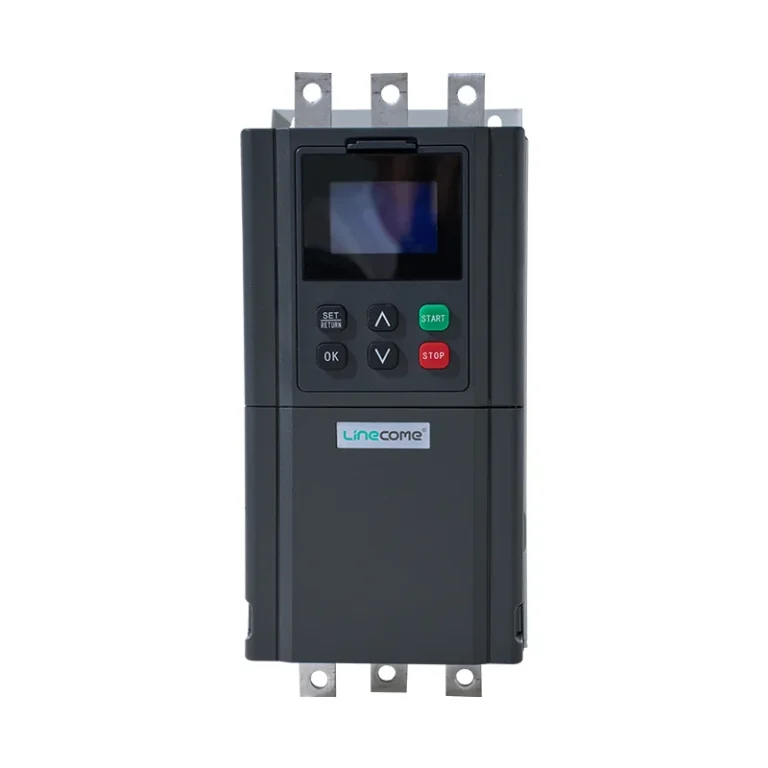
When the checklist blocks wye-delta but the duty remains fixed-speed, anchor SCR reduced-voltage start to the public ZR800 online soft starter family and cite published protection and monitoring rows—not generic “soft start module” wording.
On the public ZR800-18.5-90KW online soft starter product page, the published feature overview lists twelve protection functions and monitoring fields for current, voltage, phase sequence angle, frequency, and cumulative runtime.
That overview row set also includes 4–20 mA output at 0.5% linear accuracy where instrument loops are specified—calibrate on site before trusting the loop.
 .
| Published ZR800 feature (verify on submittal) | Application use on fixed-speed duty | Buyer verify on site |
|---|---|---|
| 12 protection functions (feature list) | Aligns with plant motor protection expectations | Trip classes vs motor thermal model |
| Monitoring of I, V, phase sequence, frequency | Maintenance visibility on repeat starts | CT orientation and display scaling |
| 4–20 mA, 0.5% linear accuracy (features list) | Plant instrument tie-in | Loop power and calibration |
| Online soft starter series bands by kW | Match motor FLA and duty | Enclosure, bypass policy, cooling |
Match the exact ZR800 kW band to motor nameplate amps before order—public pages describe series capability; the RFQ still needs the correct catalog row.
Frequently asked questions
These answers summarize the application map above for spec writers who search by question phrasing. Each reply stays bounded to fixed-speed wye-delta duty, six-lead gates, and routing to SCR soft start or VFD—without restating the full pros/cons table on the cousin page.
Where is star-delta motor starting still applied in industrial plants?
On fixed-speed pump, fan, and compressor motor branches where plant standards still specify wye-delta reduced-voltage start, delta run at line frequency, and the motor wiring supports the scheme.
Which load types commonly specify wye-delta starting on bid tabs?
Utility and transfer pumps, centrifugal fans and AHUs, and fixed-speed compressor motors on legacy or standardized starter lists—when run Hz does not change during production.
What motor wiring is required before star-delta is a valid application?
Six accessible leads or nameplate wiring explicitly supporting wye-delta switching between start and run connections.
When should procurement choose a soft starter instead of star-delta for the same duty?
When the duty stays fixed-speed but six-lead access, transition dip, or maintenance preference for SCR ramps blocks wye-delta contactor switching.
When should procurement choose a VFD instead of star-delta starting?
When run speed or production acceleration must change output frequency, or when harmonics and speed-control commissioning are already in scope for the branch.
Does star-delta application change running speed during production?
No—after delta connection the motor runs at line frequency like a fixed-speed install; speed changes require a VFD or mechanical flow control.
What checklist should buyers run before approving wye-delta on a retrofit tag?
Verify leads, inertia at transition, fixed-speed scope, duty class, protection for inrush versus overload, and whether site standards already specify SCR soft start for that kW band.
What catalog alternative fits when transition dip or six-lead limits block star-delta?
Specify SCR reduced-voltage start and cite public ZR800 online soft starter protection and monitoring rows on the RFQ when the duty remains fixed-speed.