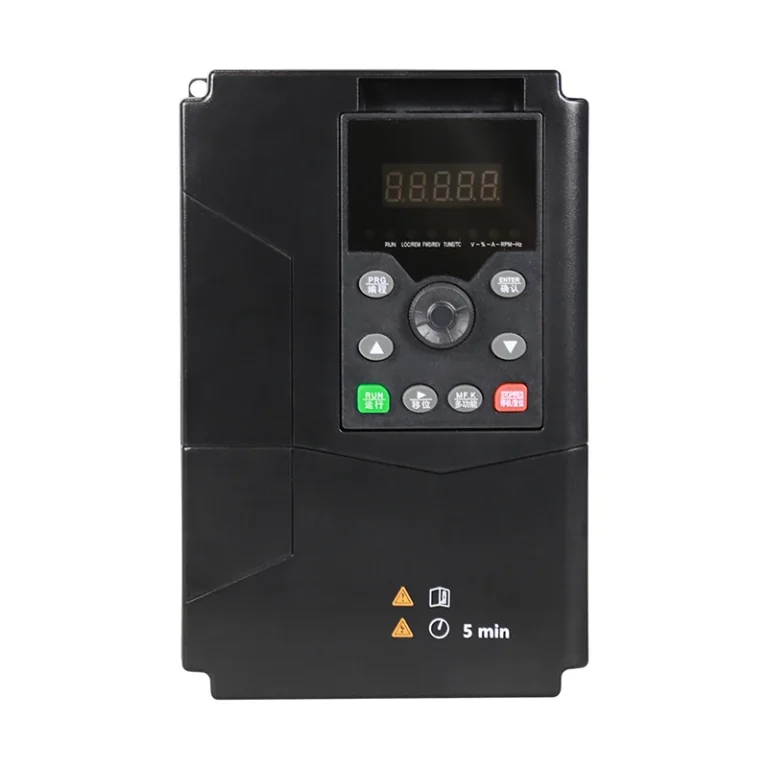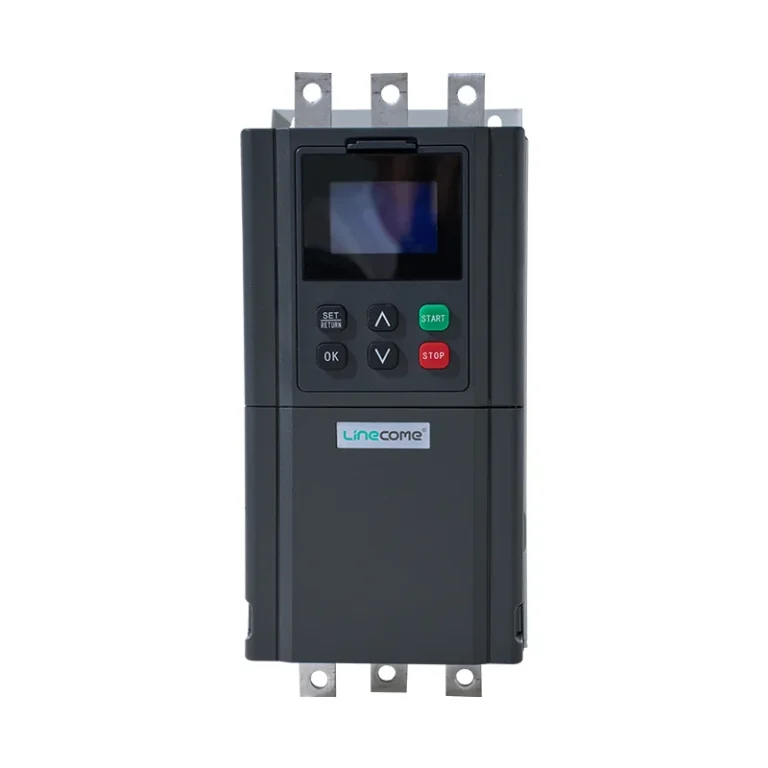

The basic principle of static frequency converter hardware is solid-state power electronics that change output frequency without a motor-generator set: incoming AC is rectified to DC, stored on a DC link, then inverted to adjustable-frequency AC at the load terminals.
Procurement readers decoding static frequency converter language on quotes should expect that three-stage chain on industrial motor drives—not a hobby one-box inverter missing a line-side rectifier, and not a spinning rotary frequency changer. For full VFD physics and control modes, read how VFD works; for rectifier–link–inverter block icons on datasheets, see AC to AC frequency converter circuit—those cousins go deeper on mechanism and blocks while this page owns the static frequency converter name and principle framing.
When the buying task is matching utility Hz to a motor nameplate, use 50 to 60 Hz frequency converter or 400 Hz to 60Hz frequency converter instead of re-deriving principle here. The Variable Frequency Drive hub collects catalog series after you accept static conversion on the branch.
 .
How this static principle page differs from VFD mechanism and Hz blogs
Static frequency converter quotes on motor branches describe what class of hardware you are buying—electronic AC–DC–AC frequency synthesis—while sibling URLs specialize adjacent tasks without repeating the same H2 stack.
| Reader task | Read on vfdelec.com | This page supplies |
|---|---|---|
| PWM, vector, or control-mode depth | how VFD works | Principle name only; cross-link |
| Block diagram on a vendor PDF | AC to AC frequency converter circuit | Principle vs block labels |
| Import 50 Hz motor on 60 Hz utility | 50 to 60 Hz frequency converter | Not Hz-pair selection |
| Electrical acronym “VFD” on specs | VFD electrical meaning | Static converter synonym context |
Keeping those boundaries avoids cannibalization: one URL owns basic principle of static frequency converter, siblings own mechanism tutorials and Hz matching.
Basic principle of static AC to AC frequency conversion
Static AC to AC frequency conversion on industrial motor hardware follows rectifier → DC link → inverter:
- Rectifier converts fixed-frequency incoming AC to pulsating DC.
- DC link capacitors filter and store energy so the inverter can switch independently of instantaneous line angle.
- Inverter synthesizes variable-frequency AC (and coordinated voltage program) at the motor terminals.
That AC-DC-AC chain is the static frequency changer principle buyers mean when a quote says “static frequency changer” for a drive-class product—electronic conversion, not a shaft spinning a generator.
Utility-fed motor branches in North America and Europe typically present 50 Hz or 60 Hz at the drive input terminals; the static converter principle does not replace verifying input voltage class and grounding on the vendor submittal—it explains how frequency at the motor changes electronically while the line stays at utility frequency upstream of the rectifier.
 .
Control electronics sit parallel to the power stages: they command switching patterns; they do not replace the three power blocks on the one-line diagram.
Important: Talk:Variable-frequency drive notes that packaged drives differ from hobby inverter builds that skip a proper line-side rectifier and DC bus—industrial static frequency converter claims assume a complete AC–DC–AC power path, not a discrete-parts science project.
Static frequency converter versus rotary converter sets
Rotary converter sets use a motor-generator arrangement to produce a new frequency mechanically—kVA sizing, bearing maintenance, and floor space differ from cabinet VFDs.
| Aspect | Static (electronic) frequency converter | Rotary frequency converter |
|---|---|---|
| Energy conversion | Semiconductors on AC–DC–AC chain | Rotating machine |
| Typical plant footprint | Drive cabinet on motor branch | M-G set skid |
| Maintenance theme | Capacitors, fans, heat sinks | Bearings, alignment, lubrication |
| Quote vocabulary | Static changer, VFD, AC drive | Rotary frequency changer, M-G set |
Choose rotary when plant standards or load types already mandate spinning conversion—otherwise motor-branch quotes labeled static frequency converter almost always mean the electronic chain in the previous section.
 .
When a VFD quote is the same static conversion class
On a single motor branch, a variable-frequency drive is the catalog form of static frequency converter most buyers actually receive: the same rectifier, DC link, and inverter power chain, plus motor control firmware.
Talk:Frequency changer threads note vendors still write “static converter” on line items that ship as packaged VFDs—treat that as naming alignment, not a different power topology, unless the submittal shows a rotary skid or a direct cycloconverter layout.
 .
Harmonics planning, cable length limits, and speed-loop tuning remain VFD commissioning tasks even when the quote said “frequency converter” instead of “VFD.” Treat every motor-branch solid state frequency converter line item as inverter hardware until the submittal proves otherwise.
Cycloconverter boundary versus DC-link static converters
Cycloconverters implement direct AC–AC frequency change for some high-power, low-speed applications— a different static topology than the DC-link VFD chain that dominates general-purpose catalogs.
Default LNC-class drives on vfdelec.com follow the rectifier–DC link–inverter pattern described above, not cycloconverter power flow. If a vendor one-line diagram shows AC-in to AC-out without an explicit DC bus, stop and ask which static topology they mean before comparing apples to apples on price.
Buyer checklist for static converter claims on datasheets
A datasheet is acceptable for plant review only when the static frequency converter one-line diagram shows a complete electronic AC–DC–AC chain, names input and output terminals separately, and documents protection—not when marketing copy replaces the power-stage drawing.
Before accepting a static frequency converter submittal:
- Confirm three power blocks on the diagram: rectifier, DC link, inverter.
- Confirm control section is drawn separately from power semiconductors.
- Confirm input voltage and frequency class match utility or transformer feed on the motor branch submittal—verify nameplate values rather than assuming.
- Reject DIY BOM language or discrete component values as proof of industrial static conversion—those belong in lab builds, not plant RFQs.
- Cross-link block-level questions to AC to AC frequency converter circuit after principle sign-off.
 .
LNC610 and LNC820 product fit after principle acceptance
Once the quote’s static frequency converter claim maps to AC–DC–AC drive hardware, match motor kW and voltage class to published catalog rows—principle acceptance does not replace ampacity sizing.
The public LNC610 general-purpose VFD series page lists output frequency 0–500 Hz, V/F control and SVC vector control, and Modbus RS485 on its published parameter overview. On the LNC820 general-purpose VFD series page, the published overview repeats the same 0–500 Hz span, V/F and SVC modes, and RS485 interface line used across the general-purpose band—verify the exact SKU against motor amps before purchase.
 .
| Published overview row (verify on submittal) | Why it matters after principle OK | Buyer verify |
|---|---|---|
| 0–500 Hz output span | Shows electronic frequency command range | Motor mechanical limits at low Hz |
| V/F and SVC modes | Control strategy after static chain accepted | Motor data for vector where required |
| Modbus RS485 | Supervisory interface on many skids | Network map and baud |
| Voltage class on chosen SKU | Input matches branch feed | Nameplate vs utility |
Use published 0–500 Hz and control-mode rows to shortlist LNC610 for smaller general-purpose branches and LNC820 for broader kW bands—then match exact model to motor FLA before order.
Frequently asked questions
Short answers below mirror the research FAQ map for buyers who search by question phrasing. Each reply stays at principle and naming depth—mechanism tutorials and Hz-pair selection stay on linked siblings.
What is a static frequency converter in industrial power systems?
Electronic equipment that changes output frequency using a rectifier, DC link, and inverter—without a motor-generator set.
What is the basic principle of static AC to AC frequency conversion?
Incoming AC is rectified to DC, buffered on a DC link, then inverted to variable-frequency AC at the load.
How does a static frequency converter differ from a rotary converter?
Static units use semiconductors on an AC–DC–AC chain; rotary units use spinning motor-generator equipment.
Is a VFD the same thing as a static frequency converter on a motor branch?
For most motor-branch quotes, yes—the packaged VFD implements the static AC–DC–AC chain plus control firmware.
Where do cycloconverters fit compared with DC-link static converters?
Cycloconverters are a niche direct AC–AC static topology; general-purpose VFD catalogs use a DC link between rectifier and inverter.
Does understanding the principle mean I should build a converter from discrete parts?
No—plant RFQs should specify industrial drive hardware with documented power stages, not hobby component lists.
How is this page different from how a VFD works or AC-to-AC circuit block articles?
This URL owns static frequency converter naming and the AC–DC–AC principle; siblings teach control physics or block-by-block datasheet reading.
Where do LNC610 and LNC820 fit after the static conversion principle is accepted?
Use their published 0–500 Hz and control-mode overview rows to shortlist a series, then size the exact SKU to motor amps and voltage class.